
The Proven Dental Marketing Strategies for Growing Your Practice in 2026
Most dental marketing strategies published online are general small business marketing with the word dental inserted. They ignore the two things that actually determine whether a dental practice grows: that patients are choosing based on trust rather than price, and that the entire addressable market is people within a few kilometres who happen to need a dentist right now.
This guide sets out the strategies that work specifically for dental practices, in the sequence that produces results fastest, based on what we see working for clinics in Pakistan and internationally.
Start With the Constraint, Not the Tactic
Before choosing tactics, identify what is actually limiting your practice. Most clinics that have plateaued are limited by one of four things, and working on the wrong one wastes effort.
Not enough enquiries. The chair has capacity but the phone is not ringing. This is a visibility and demand problem.
Enquiries that do not convert. Plenty of calls and form submissions but a low proportion become booked appointments. This is a response and conversion problem, and it is the most common constraint we find.
Patients who do not return. New patients attend once and never come back for routine care. This is a retention problem and it quietly caps revenue regardless of how many new patients arrive.
Low value per patient. Plenty of patients but predominantly for low-value routine work, with higher-value treatment rarely discussed or accepted. This is a case presentation problem.
The dental marketing strategies below are organised so you can apply them to whichever constraint is actually yours.
Strategy One: Own Local Search
For dental practices, local search visibility is the highest-value asset available. When someone in your area searches for a dentist, the map results appear above everything else, and most people choose from the first three.
The Google Business Profile is the primary lever. Complete every field, list every treatment individually with its own description, select accurate secondary categories, upload genuine photographs of the actual practice regularly, and post updates weekly.
Review volume and recency drive local ranking more than almost anything else you control. A practice with thirty reviews from the last three months typically outranks one with two hundred from three years ago.
Our full guide on local SEO for dental clinics covers the complete process, and our SEO service delivers it for dental clients.

Strategy Two: Answer Enquiries Instantly
This is the strategy that produces the fastest measurable change and the one most practices overlook because it feels operational rather than promotional.
The majority of dental enquiries arrive outside working hours. Evenings, weekends, and the moment someone finally decides to deal with the tooth that has been bothering them. A practice that responds the next morning is frequently responding to someone who booked elsewhere the previous evening.
Automated immediate response changes this without requiring anyone to work late. An enquiry triggers a message within a minute, using the person’s name and referencing what they asked about, with a link to book. A follow-up sequence continues over the following days for those who do not book immediately.
Nothing about the marketing changed. The same enquiries arrive. Substantially more become appointments, which improves the return on every pound already being spent on advertising.
Strategy Three: Reduce the Anxiety Barrier
Dental anxiety is the single largest barrier between a potential patient and your chair. Any marketing that reduces it increases bookings, and very few practices address it deliberately.
Video is the most effective tool available for this. A dentist explaining calmly what a root canal actually involves, step by step, including what the patient will feel, does more conversion work than any list of credentials. Our guide on dental video marketing covers exactly what to film.
Written content works alongside it. Procedure explanations, honest content about cost, and guidance for people who have not seen a dentist in years all intercept the specific worry that is causing hesitation. Our guide on dental content marketing covers what to write.
A clinic tour removes the fear of an unfamiliar environment. A single walkthrough video showing reception, waiting area and a treatment room is straightforward to produce and disproportionately reassuring.
Strategy Four: Advertise by Condition, Not by Clinic
Advertising that promotes the practice reaches people who are not thinking about dentistry. Advertising that names a specific problem reaches people who recognise their own situation.
On Google, this means separate campaigns for each treatment with its own ad copy and its own landing page, plus a dedicated campaign for emergency searches which convert at the highest rate of any dental search category. Our guide on dental PPC marketing covers the structure, and our Google Ads service manages it.
On Meta platforms, it means layered campaigns that begin with problem-aware content before making any offer, because a cold social audience is not ready to book. Our guide on Facebook ads for dentists covers this, delivered through our Meta Ads service.

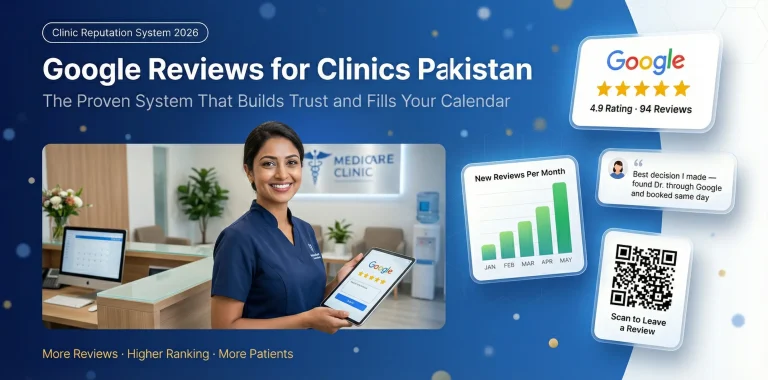
Strategy Five: Build the Review Engine
Reviews function as both a ranking signal and the primary trust signal a prospective patient evaluates. They are not a soft asset.
The practices with strong review profiles have a system rather than good luck. Every patient receives a request at the right moment, delivered by the channel most likely to produce action. In practice that means a message with a direct link sent within twenty-four hours of the appointment, not a verbal request at the desk that the patient intends to act on and forgets.
Responding to every review matters too. Google factors response rate into local ranking, and prospective patients read the responses to judge how the practice handles dissatisfaction.
Strategy Six: Reactivate Existing Patients
Most established practices are sitting on a list of several hundred people who attended once or twice and never returned. Contacting them is the lowest cost per booked appointment available anywhere in dental marketing, because the trust already exists.
Segment by time since last visit and by what treatment they had. A message referencing their specific situation performs dramatically better than a generic newsletter. Keep the frequency respectful, keep the tone clinical rather than promotional, and make responding a single tap.
Strategy Seven: Improve Case Presentation
For practices whose constraint is value per patient rather than patient volume, the highest return sits in how treatment is discussed rather than in more marketing.
Patients decline higher-value treatment for three main reasons: they do not understand why it is necessary, they are anxious about the procedure, or they cannot see how the cost is justified. All three are communication problems.
Visual explanation using diagrams or intraoral images, honest discussion of what happens if treatment is delayed, and clear breakdown of what the cost covers all measurably improve acceptance rates. This costs nothing in marketing spend.
The Sequence That Works
Clinics that grow fastest apply these dental marketing strategies in a specific order rather than all at once.
First, fix conversion. Automated instant response to enquiries. Cheap, fast to implement, immediately increases revenue from existing enquiry volume.
Second, build reviews. Systematic request process. Improves both local ranking and conversion of everyone who finds you.
Third, own local search. Complete Google Business Profile optimisation and local SEO foundations.
Fourth, add paid advertising. With conversion and reputation working, every advertising pound now produces meaningfully more revenue than it would have before.
Fifth, build content and video. The compounding long-term asset that reduces dependence on paid channels over time.
Sixth, work on retention and case presentation. Increases the value of every patient already acquired.
Practices that reverse this order, spending heavily on advertising while enquiries leak away through slow follow-up, spend more to achieve less.
To discuss which of these applies to your practice specifically, book a strategy session with our team or get in touch directly.
Research on patient decision-making in dentistry is published by the British Dental Journal, and consumer review behaviour data is published by BrightLocal.
Frequently Asked Questions
What is the most effective dental marketing strategy?
For practices generating enquiries that are not converting, automated instant response produces the fastest measurable improvement. For practices lacking visibility, local search optimisation and review generation deliver the highest long-term return.
How much should a dental practice spend on marketing?
A commonly cited benchmark is between five and ten percent of target revenue. More important than the figure is the sequence, since spending on advertising before conversion systems are working produces poor returns.
How long do dental marketing strategies take to work?
Conversion improvements show within two to four weeks. Paid advertising produces enquiries within days. Local SEO, reviews and content build over three to six months and compound thereafter.
Should a dental practice do its own marketing?
Google Business Profile management and review requests are manageable in-house. Paid advertising, technical SEO and video production typically produce better results with specialist support, particularly in competitive urban markets.
What dental marketing strategy works best in Pakistan?
Local search visibility combined with WhatsApp-based enquiry follow-up performs particularly well in the Pakistani market, because patients research on mobile and expect messaging rather than email as the primary contact channel.